Friday, July 31, 2015

Burnin’ Down the House – Part I

No, not this one ...


No real topic this week, but, rather a story. A tale from my misspent youth. If you want to see a larger moral in it, such is your right. None is intended.

On Facebook the other day (and don’t too many stories start that way?), someone in one of the groups of which I’m a member posted photos of her trip to Grauman’s Chinese Theatre in Hollywood. It was apparently her first trip to the theatre, so I gave her a brief summary of its recent history (mainly the renovations it’s received). I concluded by saying “Remind me to tell you about the time I almost burned the joint down.” She hasn’t, but I figured this would be a good a time as any to immortalize that evening.

As I may have mentioned on more than one occasion, I grew up in Southern California, and while (once I was able to drive) a trip to Hollywood became an, at least, weekly occurrence, in the mid- and late ’60s, it was a rare treat.

When I was a kid, there were any number of movie theatres in Hollywood, most of which were first-run and reasonably glamorous, and (for the bigger houses like the Chinese, the Egyptian, the Cinerama Dome, or the Pantages) featured reserved seating for road-show presentations. You cut a coupon out of the paper (remember newspapers?), fill it out specifying a number of dates, and mail it in (remember mail?). After a couple of weeks, you’d get your tickets in the mail, and on the appointed night, turn up at the theatre, where the friendly uniformed usher (remember uniformed ushers? No … ?) would escort you to your seats.

I have five early moviegoing memories. The earliest would be in the late 50s on Long Island, seeing 101 Dalmatians at a theatre that combined a drive-in and a walk-in the same location. I remember spending most of the evening running inside and outside, comparing what part of the movie was playing on which screen. (These were, of course, the days when parents could let their kids run wild in outdoor public places and reasonably expect they’d be safe and back when it was time to head home.)


And you wonder why I turned out the way I did?

The second was a 1961 screening of Snow White and the Three Stooges. I was only five or so, but remember thinking it wasn’t very funny. (I love the Stooges, but this was not one of their finer efforts.)


Yeah, pretty much what you'd expect ...


The third was later in ’61, not long before we moved to California. My parents took my sister and me into Manhattan so they could see Andy Griffith and Debbie Reynolds in The Second Time Around. It was at the Paramount Theatre in Times Square, a theatre that seated nearly 3,700 people and had (in memory) about 20 balconies. As with the Disney movie, though, I spent most of the evening running around and looking out at Times Square. I remember the billboards for Camel cigarettes (which featured a man blowing actual smoke rings) and Kleenex (with Little Lulu shilling for facial tissues) far better than I remember the movie itself. (Which, despite my love of old movies, I haven’t seen since.)

Times Square, circa 1960. Is it any wonder I didn't want to watch the movie?


The scene shifts to California. One of my favorite movies to this day is It’s a Mad, Mad, Mad, Mad World, which was (and is) an epic comedy that featured virtually every comic actor working in Hollywood in the early ‘60s. Many people I know love this movie. Many people I know hate this movie. There seems to be no middle ground. Unfortunately, it had the bad luck to open just about two weeks before President Kennedy was assassinated, and the country really wasn’t in a mood to watch a four-hour comedy about greedy schlemiels. My most vivid memories about the evening were that it was the first time I went to the Cinerama Dome in Hollywood (which came to be a theatre I’d know very well) and that, when my father took us to dinner across the street before the movie, I managed to spill an entire glass of milk on my sister. That’s great stuff when you’re seven.

The Dome

Okay, so finally moving on to the Chiniese. I’m not entirely sure if the first movie I saw there was Mary Poppins or Thunderball, but I assume it was the former. Regardless, it began another long relationship with the theatre that has continued until, well, this year.

I’ve just realized that to continue this story will need more space to finish than is practical, so I’m going to leave it here – giving me both the necessary time and a topic for next time. So, until then, let me leave you with this cryptic preview: If you have a cold, don’t let your sister drive – unless you bring a flashlight.

Friday, July 17, 2015

Art May Not Be a Democracy – But It’s Not a Dictatorship, Either

As I’ve mentioned, one of my favorite pastimes is watching old movies and TV shows. In my case, “old” means shows of the 1950s and ‘60s. (As I write this, I’m watching episodes of What’s My Line? and I’ve Got a Secret.)

 "Do you deal in a service or a product?"

With old television in mind, I had another one of those coincidences today that makes writing these posts so interesting.


The first part of it was an episode of Naked City, which was an early cop show. Based on the movie of the same name, one of the things the show (like the movie) was notable for was being shot on location in New York. In fact, the narration of the film (and the first season of the show) mentioned how all the locations were real and that there were no sets. (As the show went on, this “rule” was broken regularly, and obvious sets were used. In fact, there’s one set of a duplex apartment that gets used so much in the second season to represent different locations, that they must have thought the audience had the attention span of a gnat.)

The main reason I watch the show, now, though, is that it features early appearances by “New York” actors who have gone on to greater things. (Nowadays, of course, the only way to see New York actors is to see Equity shows in the Bay Area … ) It’s interesting (for me, anyway) to see Dustin Hoffman, Robert Redford, Robert Duvall, Peter Falk, Maureen Stapleton, Sandy Dennis, Christopher Walken, and (my favorite so far) William Shatner as a Burmese sailor with a German accent. This week’s episode featured George C. Scott as a sculptor who had been commissioned to create a statue of a revolutionary leader. In an obvious analogy to Fidel Castro, the revolutionary became a dictator, and Scott’s character came under incredible pressure to stop sculpting and destroy the statue. Despite a cash offer of $20,000, pickets at his apartment house, and even a sniper killing his pregnant wife, Scott refuses to give up on the project because Art is more important than anything else ...


Or something.


Now, I’ve long advocated for art that gets people agitated and causes controversy, but this was taking it too far for even me – especially when the sniper shot the statue itself. (Spoiler: Scott keeps sculpting it, plugging the bullet holes with clay.)
 "Look out! He's got an axe!"

(By the way, after searching for images from Naked City, I just want to warn you: don't do Google Images searches for "Naked City." Just sayin'.)


The second part of the coincidence actually came earlier in the day when I read this story. In Manchester, England, there’s an artist named Douglas Gordon. He’s won the Turner Prize, but his work seems to consist of adapting and mashing the work of other, better artists and taking credit for the results. (See also “Lichtenstein, Roy”) As far as I can tell, Mr. Douglas has neither a theatrical background nor training, but was nonetheless engaged to direct a show in a relatively new $40 million theatre. (I’ll pause here while my brother and sister artists wonder A) why and how Manchester spent $40 million on a theatre building while our own governmental agencies provide next-to-no support for theatre companies, and B) how and why an artist was hired to direct a play when so many qualified directors can’t get work. Must be an English thing … )


The answer to the latter question may be found on the theatre’s website: Manchester International Festival “has invited Turner Prize-winning artist Douglas Gordon (Zidane: A 21st Century Portrait) and celebrated pianist Hélène Grimaud to create Neck of the Woods, a portrait of the wolf brought to life in a startling collision of visual art, music and theatre.” I guess because they don’t have enough wolf theatre in northern England. (Who does, really?)


Despite the presence of actress Charlotte Rampling, the BBC reported the general media reaction:


The Daily Telegraph said Neck of the Woods had “the unmistakable whiff of a vanity project,” with a script that “simply isn’t very good,” while “Rampling looks terribly uncomfortable most of the time.”


The Guardian, meanwhile, described it as a “humorless and sedate Red Riding Hood retelling” that “takes itself very seriously” and is “so old-fashioned you wonder if Gordon has any familiarity at all with contemporary theatre.”


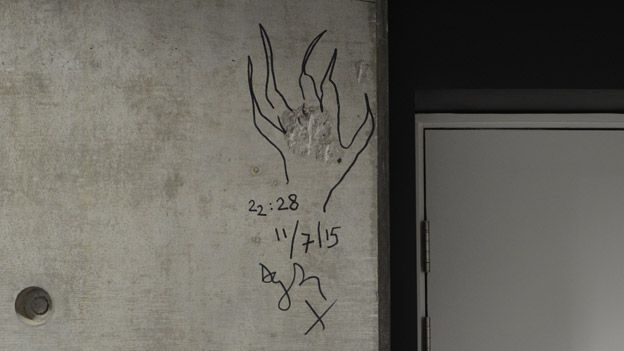
Well, Mr. Gordon took exception to the notices and decided to take matters into his own hands – literally. The BBC notes that “the show begins with the sound of an axe, and the stage has a number of axes screwed to it.” Mr. Gordon took one of those axes and tried to chop a hole in the theatre’s concrete walls. After knocking out a few chunks, he drew a demonic hand around the holes, then signed and dated the resulting “artwork.”
This guy ...
...did this.

As might be expected, the facility’s management didn’t take kindly to the act and will be allowing Mr. Turner to pay for repairing the damage. (Apparently, management doesn’t feel the benefits of having this uncommissioned sculpture outweigh the chance to get rid of it.)


If you haven’t guessed by now what these two have in common, it’s not that sculptors are stubborn boobs (well, not all sculptors ...); it’s that there are times you really need to let go and not take your work so goddamn seriously. I’ve never quit a show (I may have once, but I’m not 100% sure), but if someone offered me the equivalent of $150,000 to stop working on one, I admit I’d to consider it. And in the second case, who the hell takes reviews that seriously? Well, Mr. Gordon does, but what anger management issues does a guy have that he reads his reviews, gets mad, tries to figure out what to do, makes up his mind, puts on his shoes, gets a jacket, finds his keys, gets in his car, drives to the theatre, goes in, says hello to the staff and crew, heads into the house, finds a way to remove one of the axes he’s attached to the stage, then attacks the concrete wall of a new theatre because some reviewer thought you were humorless – which is something you’ve just, ironically, proven.


We’ve all gotten bad reviews (and if you say you haven’t, you’re a liar – or an amnesiac), but we’ve all laughed them off or called the reviewer “an asshole who just didn’t get it” and moved on. But this guy? I don’t want to see anything by this guy.


There was actually a third story I also heard about this week, but it’s one that will go unmentioned because there are things I just can’t – or shouldn’t – talk about. Suffice it to say that, when I saw a quote on Facebook (and I hate quotes on Facebook) that said something to the effect of “Just because you’re offended doesn’t mean you’re right,” I took it to heart – and that comes from an opinionated hothead.


To bring my headline into this, no, Art isn’t a democracy. If you solicit opinion before making a movie or pander in an attempt to make everything appeal to the lowest common denominator, you’re just going to end up with a bunch of bland crap. (Although I have to admit this formula has been working for Disney for decades.) You’ve got to be bold and individual, even at the risk of offending people. I know I’ve seen a lot of stuff I didn’t like, but (in most cases) it was because I didn’t agree with the choices the director made. I’d rather watch an evening of bold, stupid choices than a bunch of stupid non-choices. At least the first one makes me think of how I’d do things differently.


On the other hand, if you’re so bloody-minded and determined to make art that, if you’re criticized or corrected, your only recourse is to hit a building with an axe or let your wife get shot, well, that’s another stupid choice.

Friday, July 3, 2015

Starting Over

I’ll be honest with you. I just abandoned another post when I realized, 500+ words in, that it just wasn’t working. If nothing else, I was in danger of saying some things that could easily be misunderstood and give too many wrong impressions.

So I decided to deal with something less controversial: namely, what the hell is wrong with audiences these days?

As an actor, I’m used to working with audiences that are up close and personal. My high school’s theatre was in the round, and the seats were thisclose to the stage, so I had early training in being aware of the audience while ignoring them. I mean, I’m always aware of them and their reactions, but I’m not concentrating on them. This has especially helpful in the last few shows I’ve done, that have either been on thrust stages or in interactive spaces. Believe me, we see everything, but learn to ignore it.

The musical I’ve been doing has been extremely (and rightfully) popular, and we’ve had only a few empty seats the entire run. One of my favorite parts of this show is my big number in the second act. I get to sing right to the audience and get in their faces in a positive way. And every night, I’m able to take inventory of who’s still with us, who’s checked out, and who’s asleep. (Literally.) One of the good things about the show is that we’ve gotten a wide variety of types of people. Having a number of different types in the audience pretty much guarantees that there’ll be plenty of varying reactions. Everyone is going to react to the show differently. I’ve found that I don’t like playing before large groups that have come to the show together (benefits are particularly bad in this regard). They’re all of the same mind, so if one of them finds something entertaining or funny, they all will, and will all react in the same way. That’s fine when they like a show, but when they don’t, it’s deadly. You can be doing everything right and well, and they just sit there like an oil painting. Take our last performance. We had a group of college students who couldn’t have been less interested in watching the show. They were dutiful, they applauded, took notes, and stayed until the end, but they were there only because they were supposed to be. Now, please note: I don’t fault them for being uninterested. Not everyone likes every show. (Goodness knows I’ve seen plenty I didn’t like.) 

Not quite this bad - but almost

What I can’t understand is why someone would either go to a show they really had no interest in seeing or why they’d stay. Well, I know in one sense; it’s something that my wife and I have dubbed “Obligation Theatre.” In most cases, I want to see something or I won’t make the effort to buy a ticket and leave the house. But, every so often, someone I know is doing a show, and despite my worst fears and expectations (“They’re/he/she doing that? <Rolls eyes>), I go and endure a couple hours of pain because I want to support a friend, even in the most perfunctory sense.

But, that aside, every actor has stories about audience members who misbehaved. Just tonight, in addition to the dullards at my own show, I heard reports from another show about audience members who used the set as a place to set their bags, who went into the lobby during the show to complain to the cast about the temperature in the theatre, then stood in their way when they were trying to make their entrances and a couple that argued in the parking lot at intermission because the husband had fallen asleep during the first act. (They left.) During our production, we’ve had a number of sleepers, and at least one woman who thought the emotional 11 o’clock number was the perfect time to check her phone, and another who was in such a rush to leave, she ran smack into one of the actors trying to make her curtain call. (And don’t even get me started on the audience members who use the curtain call as the perfect opportunity to rush out of the theatre as though the joint was on fire. Are they really going to save that much time?)

We’ve probably all dealt with cell phones going off or talkers or singers-along or eaters or texters or latecomers or the deathly ill, but I can’t imagine how these people have been so sheltered that they don’t comprehend that they can be heard or seen or smelled or detected; that they’ve developed some kind of force field of invisibility that prevents anyone else in the audience or cast from detecting them.

An actor I once worked with had worked with another actor in the West End who had a unique way of dealing with latecomers, especially those who were down front. He’d stop the show, welcome them, make sure that they had programs and knew who everyone on stage was and what had happened thus far. Once he was sure they were well-informed, he’d ask for permission to start again. One can be pretty sure that these folks were never late for the theatre again. Similarly, in the days when people had to use cameras, rather than phones, to take photos at shows, when Katharine Hepburn would spot one of them, she’d stop the show, walk downstage, demand that the photographer stand and take all the photos he or she wanted because their needs were more important than those of anyone else in the theatre. When she was satisfied that the person had had their fill, she resumed the show. Laurence Fishburne once stopped a performance of The Lion in Winter when a phone went off. He stopped, looked at the audience with a lethal stare, and intoned “Tell them we’re busy.” I once saw Christopher Walken halt a cross from stage left to right when another phone went off. He stared at the audience in a Walkenesque way, with a look on his face that indicated his character couldn’t tell if he was hearing things or something was actually happening. When the phone stopped, he kind of shrugged and resumed the cross. Dennis O’Hare, in Take Me Out, was in the middle of a monologue when someone in the audience sneezed. Without missing a beat, he said “Bless you” and continued the speech. And we all know how Patti LuPone reacted to a photographer.

Don't screw with Patti

While all of those responses are admirable (to me, anyway), in almost every case when I’ve had to deal with a moment like these, I’ve made the choice to just ignore the interruption or sleeper or noise or smell, and I have to wonder why. We all know it’s happening, it’s disruptive and annoying, but we all suspend our disbelief and pretend it’s not happening or it’ll stop eventually.

I guess it’s just the easy way out or that we want to avoid confrontation or that it’s not worth the effort to break the illusion.

As I said at the beginning, this was a substitute for another post, so I’m not sure what my ultimate point is other than to complain and urge all of us – myself included – to stay awake, alert, and involved when we go see a show. Even the worst of shows has some value, even if only as an example of how bad something can be. If I could make it through The Lily’s Revenge without throttling someone, there’s nothing that can’t be endured.